



Making the railway the most beautiful place in the sky
Getting to an airport is often a source of stress for travellers. Unpredictable weather, traffic congestion and reliance on private cars: for many, the journey to the terminal remains the most unpredictable part of the trip. In response to these challenges, major French cities are stepping up the development of direct rail links between city centres and airports.
Automated metros, trams, RER trains, regional express trains or dedicated shuttle services: these transport systems address several challenges at once. They improve the flow of traffic, reduce the carbon footprint of airport access routes and enhance the travel experience for passengers, whether they are local residents or visitors.
Better-connected terminals: a new standard in mobility
For major cities, effectively connecting an airport is no longer just a question of accessibility. It is a matter of attractiveness, urban planning and the green transition. Airport hubs have become true mobility hubs, where local, national and international flows intersect.
In this context, rail connections are gradually becoming the norm. Automated metros, trams or express services enable the airport to be integrated into the public transport network, just like a railway station or a major urban centre. The aim is no longer simply to reach the terminal, but to make the airport a destination that is fully connected to the wider region.

3 questions for Sébastien Million
Head of the Urban Transport Projects Agency at ETF
Why have rail links to airports become so important for cities?
Above all, these projects offer travellers an additional option. The metro or tram becomes a link connecting the urban network to national and international transport networks. In some cases, you can leave your home and reach the airport without a car, using only public transport. This is evident, for example, in Nice, where the tram line directly links the port, the city and the airport, with connections to the railway station. This interconnection completely changes the way people travel.
What concrete changes do these projects bring for travellers?
There is, of course, the environmental aspect, but there are also gains in terms of time and reliability. Today, travelling from Orly to Gare de Lyon takes about twenty minutes on line 14. When it’s fast, regular and energy-efficient, people naturally adopt this mode of transport.
Building these lines in the heart of cities must also be a challenge for construction companies like ETF…
Yes, definitely. During construction work, we’re rarely very popular. We work in busy areas, we divert traffic, and we dig up the roads. This inevitably causes disruption for local residents and shopkeepers. Our challenge, therefore, is to plan with our clients and organise the worksites so that we can make efficient progress whilst maintaining traffic flow and safety. There is a lot of pressure to meet deadlines and a great deal of coordination between contractors, but once the line is up and running, local residents very quickly see the benefits.
A range of responses depending on the region
Whilst the challenges are many, the range of possible solutions is just as wide. Take the CDG Express, for example: the focus here is on direct service. The future link will connect Gare de l’Est to Paris-Charles-de-Gaulle Airport without any intermediate stops, offering a clear promise to passengers: to arrive on time, whatever the traffic conditions. Conversely, the Nice tramway illustrates another way of thinking about airport connections. Here, the rail system is not limited to providing a fast link: it serves the city. The line serves the terminals directly whilst passing through urban neighbourhoods, linking the airport to residential areas, business parks and other modes of transport. The challenge is not just speed, but seamless integration into the urban fabric, coexistence with other uses and the reliability of the service in a very busy environment.
Making a corporate decision
Connecting an airport by rail is not merely a matter of solving a technical problem. It marks a genuine paradigm shift. It embodies a societal choice: to reduce dependence on cars, make travel more predictable, and ensure that long-distance travel is carried out in a more sustainable manner.
The extension of Paris Metro Line 14 to Orly Airport fully embodies this development. Designed to serve as the backbone of Greater Paris, the project aims not only to connect an airport but also to link regions, communities and everyday activities. In this context, ETF worked as part of a consortium to build the southern extension of the line, incorporating future operational constraints right from the design stage. The construction of 14 km of double track within a tight timeframe, in the heart of a dense urban environment, required rigorous industrial organisation and close coordination between civil engineering, track laying and station fit-out. Beyond the performance of the construction site, the challenge was clear: to ensure, from the moment of commissioning, an infrastructure capable of delivering on its promise of regularity, capacity and reliability for millions of passengers.
The shift towards rail transport: a key factor in reducing greenhouse gas emissions
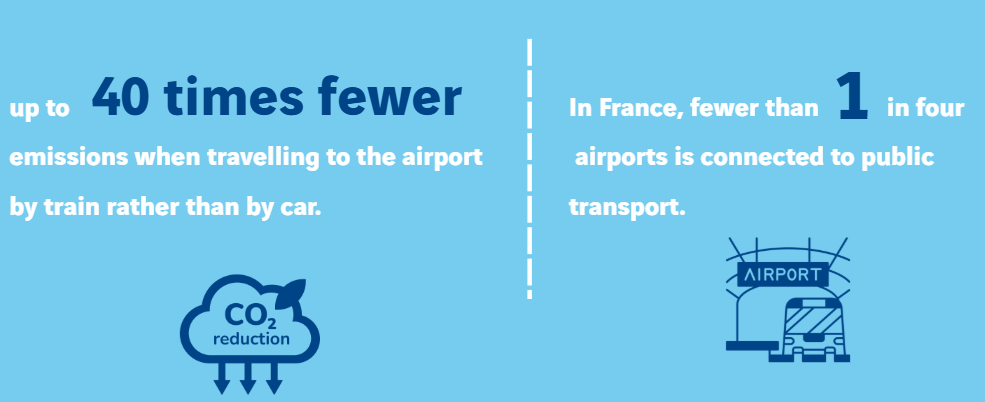
Whether it is a dedicated express service or an integrated urban tramway, these city–airport links reflect a fundamental shift in transport policy: rail is no longer merely an alternative to the car; it is becoming a central part of the passenger journey.
